
By Little 6 Industries | Last Updated: February 2026 | 8 min read
???? Table of Contents
- Why Humor Actually Works in Marketing
- The Science: What Happens in Your Brain
- Why Stickers Are Perfect for Humor
- The 5 Types of Humor That Sell Stickers
- The Shareability Factor: Why People Spread Funny Stickers
- When Humor Backfires (And How to Avoid It)
- How to Test Your Humor Before You Print
- How Little 6 Approaches Funny Sticker Design
Walk through any college campus, browse laptop lids at a coffee shop, or check out water bottles at the gym, and you’ll spot them: funny stickers. Dad jokes. Sarcastic one-liners. Absurd illustrations. Relatable humor that makes you stop, read, smile, and sometimes groan.
These aren’t just decorations. They’re tiny billboards of personality. And they sell—consistently, reliably, and often virally—because humor in marketing isn’t just entertaining. It’s one of the most effective psychological tools a brand can use.
If you’ve ever wondered why some stickers become bestsellers while others sit in inventory, the answer is simpler than you think: funny stickers tap into how our brains are wired to remember, share, and emotionally connect with content. And when done right, humor doesn’t just sell stickers—it builds brand loyalty, generates word-of-mouth marketing, and turns customers into walking advertisements.
Let’s break down the psychology, the strategy, and the science behind why funny stickers work—and how you can use humor to create designs that people actually want to buy.
Why Humor Actually Works in Marketing
The numbers don’t lie. According to Oracle’s research, 90% of consumers are more likely to remember a product or brand associated with humor. A 2019 study published in the Journal of Marketing found that ads using humor were 30% more likely to be remembered than serious ads. And humor-based social media content sees up to 400% more shares than neutral content.
But why? What is it about humor that makes it so effective?
???? Three Psychological Reasons Humor Works
1. Positive Emotional Association
When something makes you laugh, your brain releases dopamine—the “feel-good” neurotransmitter. This creates a positive association not just with the joke, but with the brand or product attached to it. Every time someone sees your funny sticker, they experience a small hit of that positive emotion again.
2. Attention-Grabbing Pattern Disruption
Our brains are wired to notice things that break expectations. Humor works by setting up a pattern and then subverting it—the “setup and punchline” structure. This surprise element grabs attention and makes the content stick in memory far longer than straightforward messaging.
3. Social Currency and Identity Signaling
People share funny content because it makes them look funny, clever, or relatable. When someone buys and displays a humorous sticker, they’re not just decorating their laptop—they’re signaling their personality, sense of humor, and values to everyone who sees it.
This last point is critical for sticker marketing. Unlike a billboard or a video ad that people passively consume, a sticker is a choice. When someone sticks it on their water bottle or car bumper, they’re publicly endorsing your message. That’s powerful word-of-mouth advertising that keeps working long after the initial purchase.
The Science: What Happens in Your Brain When You See Something Funny
Neuroscience research has shown that humor activates multiple brain regions simultaneously. When you “get” a joke, your brain’s reward system lights up—specifically the ventral striatum and dorsal striatum, areas associated with pleasure and motivation. This dual activation is why funny content is so memorable: it engages both your emotional processing and your cognitive reasoning at once.
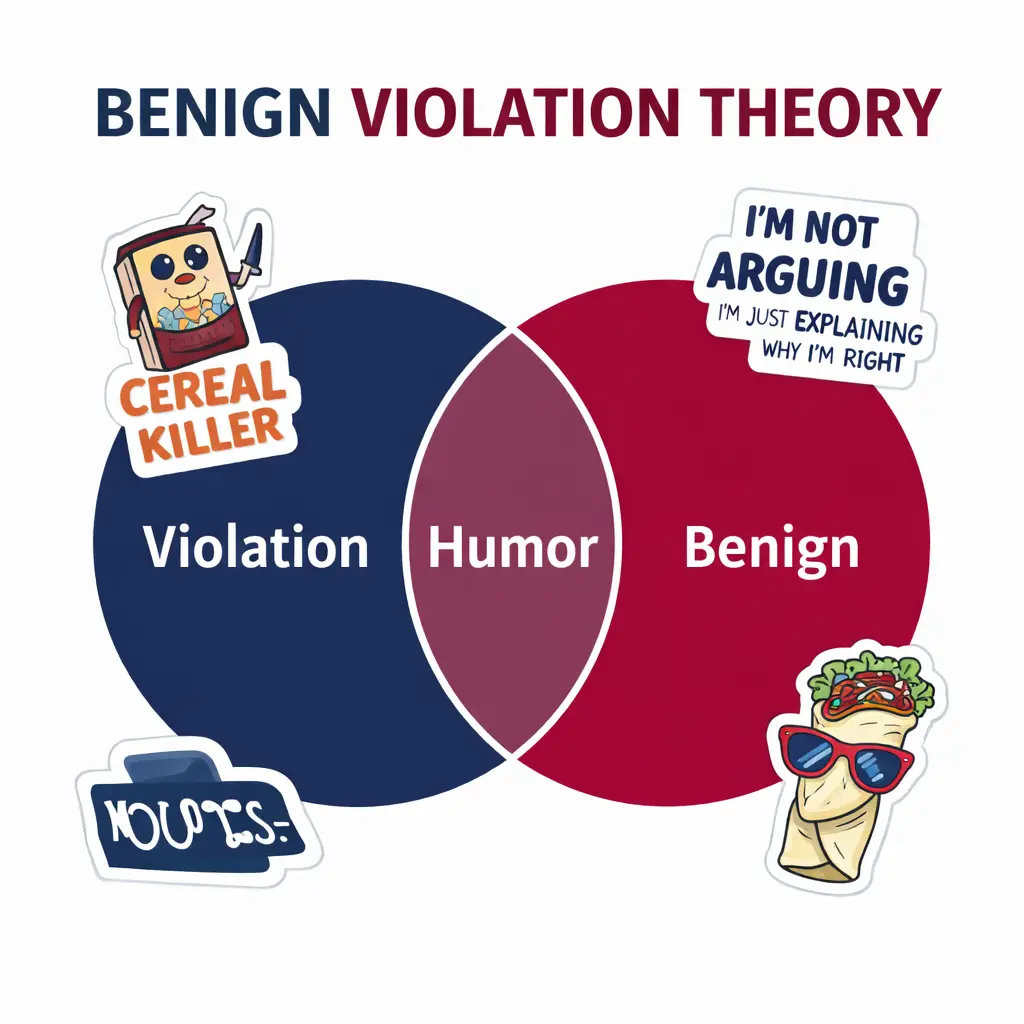
Peter McGraw and Caleb Warren’s research at the University of Colorado introduced the “Benign Violation Theory” of humor—the idea that something is funny when it violates a norm or expectation but does so in a way that’s perceived as non-threatening. This is why dad jokes work: they break the rules of “good” humor (the punchline is predictable and groan-worthy), but they do it in such a harmless, wholesome way that we laugh anyway.
???? The Benign Violation Framework for Stickers
To create humor that works on stickers:
- Find the violation: What rule, expectation, or norm are you breaking? (Example: “My other ride is your dad”)
- Keep it benign: Make sure the violation doesn’t offend, alienate, or genuinely threaten anyone in your target audience
- Land the timing: The punchline needs to hit quickly—you have 2-3 seconds max on a sticker
Studies also show that humor increases both attention span and information retention. According to research published in Psychological Science, humor creates a sense of camaraderie and shared understanding—which is exactly what builds brand loyalty. When customers feel like your brand “gets” them, they come back.
Why Stickers Are the Perfect Medium for Humor
Humor works across all marketing channels, but stickers have unique advantages that make them especially effective for funny content:
???? Why Stickers > Other Marketing Channels for Humor
1. Low Cost, High Visibility
A single funny sticker costs $2-5 but gets seen hundreds or thousands of times over its lifespan. It’s passive advertising that works 24/7 wherever the sticker is displayed.
2. Personal Expression Tool
People use stickers to curate their identity. A laptop covered in funny stickers tells a story about who that person is. Buyers aren’t just purchasing adhesive—they’re buying a piece of their personality.
3. Permanence Creates Commitment
Unlike a social media post that disappears in a feed, a sticker stays. This permanence means customers are selective—which also means when they do choose your funny sticker, it’s a strong endorsement.
4. Built-In Conversation Starter
A funny bumper sticker gets comments at stoplights. A clever laptop sticker sparks conversations in coffee shops. This organic engagement is marketing gold—you’re not interrupting people’s day, they’re actively choosing to engage with your content.
5. Perfect Format for Punchlines
The compact size of a sticker forces brevity. This constraint is actually an advantage for humor—short, punchy jokes work better than long setups. You get to the laugh faster.
The 5 Types of Humor That Sell Stickers
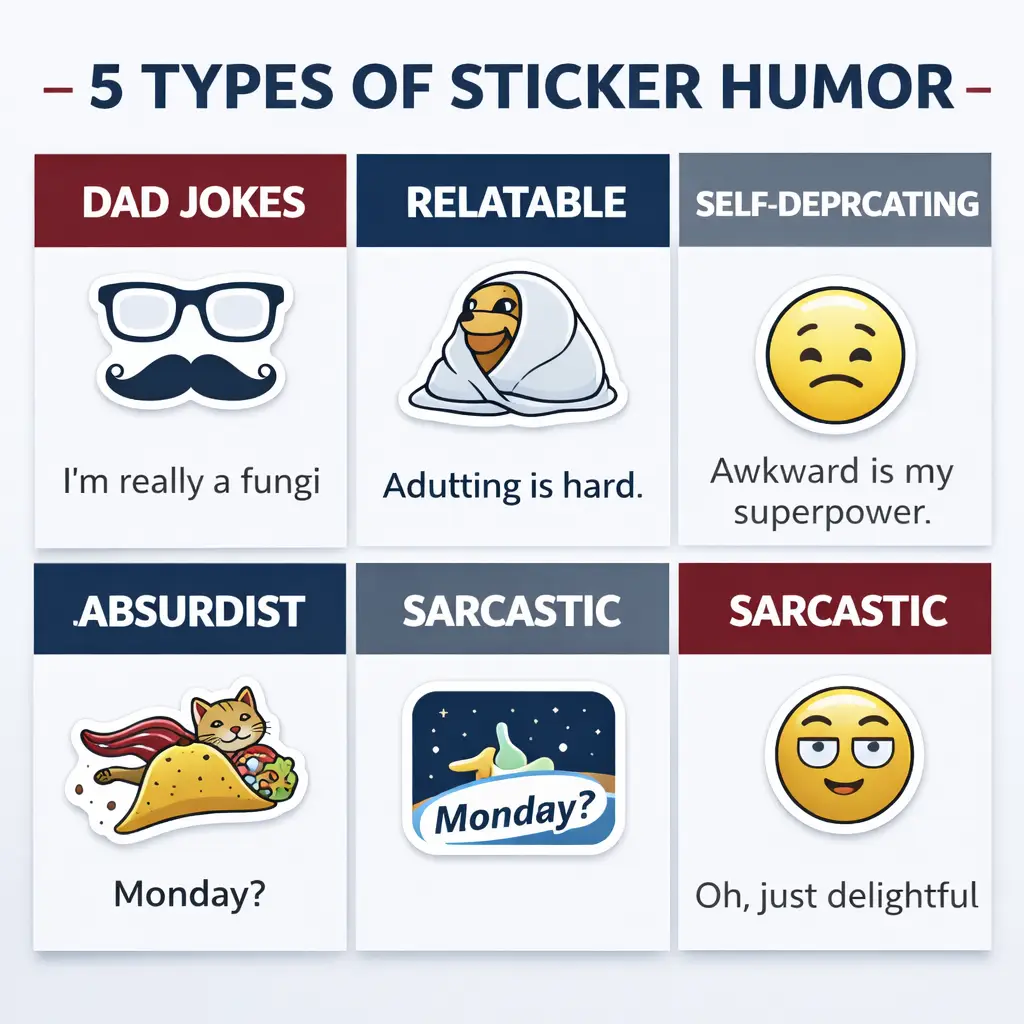
Not all humor is created equal. Different types of humor appeal to different audiences and work better in different contexts. Here are the five most effective humor styles for sticker marketing:
1. Dad Jokes & Puns — The Safe Bet
Why it works: Dad jokes are wholesome, universally accessible, and groan-inducing in the best way. They’re safe for all ages and contexts, which makes them perfect for mass-market appeal.
Examples: “I’m on a seafood diet. I see food and I eat it.” | “Toast to a Great Dad” (with toast imagery)
Target audience: Parents, millennials who appreciate ironic nostalgia, people looking for clean humor
2. Relatable Humor — “I Feel Seen”
Why it works: When a sticker perfectly captures a shared experience, people feel understood. This type of humor creates instant connection and makes customers feel like your brand “gets” them.
Examples: “I tried my best, it was barely adequate” | “This is the best I could do” | “Coffee: Because adulting is hard”
Target audience: Young professionals, students, anyone navigating modern life stress
3. Self-Deprecating Humor — Disarming Honesty
Why it works: Making fun of yourself is endearing. It shows confidence and authenticity, and it gives people permission to laugh with you rather than feeling judged.
Examples: “I’m not arguing, I’m just explaining why I’m right” | “Hot mess express” | “Professional procrastinator”
Target audience: People who appreciate honesty and aren’t afraid to own their quirks
4. Absurdist Humor — Weird for the Sake of Weird
Why it works: Sometimes things are funny precisely because they don’t make sense. Absurdist humor stands out in a sea of conventional messaging and appeals to people who pride themselves on having an “unusual” sense of humor.
Examples: Random animal mashups, surreal phrases, unexpected juxtapositions
Target audience: Gen Z, creatives, people who follow brands like Liquid Death or Duolingo’s chaotic TikTok
5. Sarcastic Humor — The Eye-Roll Special
Why it works: Sarcasm is the language of modern cynicism. Done right, it’s witty and sharp. Done wrong, it comes across as mean-spirited. The key is punching up (at systems, not people).
Examples: “I’d agree with you, but then we’d both be wrong” | “Teamwork: A few of us doing all the work”
Target audience: Office workers, anyone frustrated with bureaucracy, people who cope with humor
Pro Tip: The most successful sticker businesses don’t pick just one humor style—they offer variety. Create collections that hit different comedy notes so customers can find what resonates with their specific sense of humor.
When Humor Backfires (And How to Avoid It)
Humor is powerful, but it’s not risk-free. What’s hilarious to one person might be offensive or confusing to another. Here are the most common humor pitfalls in sticker marketing—and how to sidestep them:
⚠️ Red Flags to Avoid
1. Punching Down
Humor that targets marginalized groups, makes fun of people’s appearances, or reinforces negative stereotypes isn’t funny—it’s alienating. Always punch up (at systems, institutions, absurd situations) or punch sideways (at universal human experiences), never down.
2. Inside Jokes Without Context
If your humor requires extensive background knowledge to understand, it won’t land with most people. Stickers have 2-3 seconds to communicate. Make sure the joke is immediately accessible.
3. Trying Too Hard to Be Edgy
There’s a fine line between edgy and offensive. Before you print, ask: Is this funny because it’s clever, or am I just being provocative for shock value? Shock wears off quickly; clever humor endures.
4. Humor That Doesn’t Match Your Brand
If your brand is professional, corporate, or serious, suddenly launching absurdist humor stickers will confuse your audience. Make sure your humor aligns with your overall brand voice and values.
5. Outdated References
Pop culture references are risky because they have expiration dates. A meme that’s hot today might be cringe in six months. If you’re going to reference trends, make sure they have staying power or that you’re producing small batches you can update regularly.
The Golden Rule: If you have to ask “Is this too much?” it probably is. When in doubt, test it on a few trusted people outside your immediate circle before you commit to a full print run.
How to Test Your Humor Before You Print
The worst thing you can do is print 500 stickers of a joke that doesn’t land. Here’s how to validate your humor before you invest in inventory:
✅ Testing Methods That Actually Work
1. Social Media Polls
Post your sticker design concepts on Instagram Stories, Facebook, or Twitter with a poll. Ask “Would you buy this?” or “Which one makes you laugh?” The engagement (or lack thereof) will tell you everything you need to know.
2. Small Test Batches
Print 25-50 of a new design and sell them at cost or give them away to gauge reaction. If people love them and ask for more, scale up. If they sit in your inventory, you’ve learned the lesson cheaply.
3. Focus Group of 5-10 People
Show your designs to people in your target demographic. Watch their faces—genuine laughter, smiles, or even a “heh, that’s good” are positive signs. If they squint, look confused, or politely smile, rethink the design.
4. A/B Test Headlines
If you’re selling online, test multiple versions of the same joke or visual. Track which one gets more clicks and purchases. Let the data decide.
5. Ask “Would I Put This on My Own Laptop?”
If you wouldn’t publicly display it, why would anyone else? Personal conviction in your humor is the first filter.
How Little 6 Approaches Funny Sticker Design
At Little 6 Industries, we know that humor is subjective—but we also know what works. Our approach to creating funny sticker designs balances creativity with strategic testing, and we help customers bring their humor ideas to life with professional execution.
???? Our Funny Sticker Strategy
Start with Universal Truths: The best humor is rooted in shared human experiences. We help customers identify relatable concepts their audience will instantly recognize—whether it’s the struggle of Monday mornings, the chaos of parenting, or the absurdity of office life.
Keep It Clean (Unless You Shouldn’t): We default to humor that’s appropriate for all audiences unless a customer specifically wants edgier content for a niche market. Clean humor has wider appeal and longer shelf life.
Typography Matters: A funny phrase needs the right visual delivery. We help customers choose fonts, colors, and layouts that enhance the joke rather than distract from it.
Quality Amplifies Humor: A hilarious design printed on cheap vinyl that peels in a week isn’t funny anymore—it’s disappointing. We use UV-resistant, weather-proof materials so your funny stickers stay funny for years.
We also encourage customers to start with small test runs before committing to large orders. Print 50 stickers of three different designs, see which one sells out first, then scale up production on the winner. It’s a low-risk way to validate your humor before you invest heavily.
The Bottom Line
Funny stickers aren’t just a novelty—they’re a proven marketing strategy backed by neuroscience, psychology, and decades of advertising research. When you make someone laugh, you’re not just entertaining them. You’re creating positive associations, building brand loyalty, and turning customers into advocates who literally carry your message everywhere they go.
The key is to understand your audience, test your humor before scaling, and deliver quality that matches your creativity. A great joke on a poorly-made sticker is still a missed opportunity. But a great joke on a professionally-printed, durable sticker? That’s marketing gold.
Whether you’re launching a sticker line, adding humor to your existing designs, or just trying to understand why that one dad joke sticker keeps selling out—remember this: humor works because it’s human. And in a world of algorithmic feeds and corporate jargon, being genuinely funny is one of the most effective ways to stand out.
Ready to Print Stickers That Actually Make People Smile?
???? Shop Custom Stickers at Transfers42.com
???? Call: (520) 705-4026
???? Email: matt@little6llc.com
???? little6llc.com
???? Die-cut, kiss-cut, UV-resistant stickers | Fast turnaround | Maricopa, AZ | Veteran-Owned
Related Articles
Sources
- True Fit Marketing — The Power of Humor in Marketing
- ScienceDirect — To Humor or Not Humor Buyers? Evaluating Effective Use of Humor in B2B Advertisements
- Pop Neuro — The Psychology of Humor and Its Influence on Advertising and Consumer Behavior
- Psychology Today — Humor in Marketing: The Riches Are in the Glitches
- ScienceDirect — Is Laughter the Best Marketing? Why This Is the Wrong Question
- Humans (Vocal Media) — Why Humor in Marketing Works: The Psychology Behind the Laughs
- Fast Company — Humor in Advertising Can Cue More Than Laughter
- WARC — Why Humour in Advertising Works – and How Brands Can Use It More
- Psychology & Marketing — The Influence of Humor in Advertising: Explaining the Effects of Humor in Two-Sided Messages
- ResearchGate — Humour in Advertising: An Associative Processing Model
#little6 #little6llc #FunnyStickerMarketing #HumorInAdvertising #DadJokesStickers #StickerBusiness #ViralStickers #CustomStickers #PsychologyOfHumor #RelatableHumor
About the Author
Little 6 Industries is a Service-Disabled Veteran-Owned Small Business (SDVOSB) based in Maricopa, Arizona. We specialize in custom DTF transfers, die-cut and kiss-cut stickers, UV printing, laser engraving, and promotional products. Our mission is to help businesses and individuals turn creative ideas into professional, durable printed products. Visit us at little6llc.com or shop stickers at Transfers42.com.